
Insights
Complete Guide to Custom Closets in Leander, TX
Published September 18, 2025
Quick Summary
- Who this is for: Leander homeowners who want closets that keep up with kids, shared primary closets, and daily “drop zone” routines.
- Outcome: A layout with adjustable zones and clear categories so the system still works as your household changes.
- Cost/Timeline: Most projects fall in $2,500–$35,000+; many installs take 1–3 days after design + fabrication.
How much do custom closets cost in Leander, TX?
In Leander, most custom closet projects cost $2,500–$6,000 for reach-ins, $6,000–$14,000 for standard walk-ins, and $15,000–$35,000+ for boutique dressing rooms. Pricing is driven by finish tier, hardware quality, and add-ons like drawers, hampers, lighting, and shoe storage—plus how many rooms you bundle into one scope.
| Scope | Typical Range | Notes |
|---|---|---|
| Reach-in refresh | $2,500 – $6,000 | Great for bedrooms and kids’ closets. |
| Standard walk-in | $6,000 – $14,000 | Layout + accessories drive price. |
| Boutique dressing room | $15,000 – $35,000+ | Lighting, doors, premium finishes add scope. |
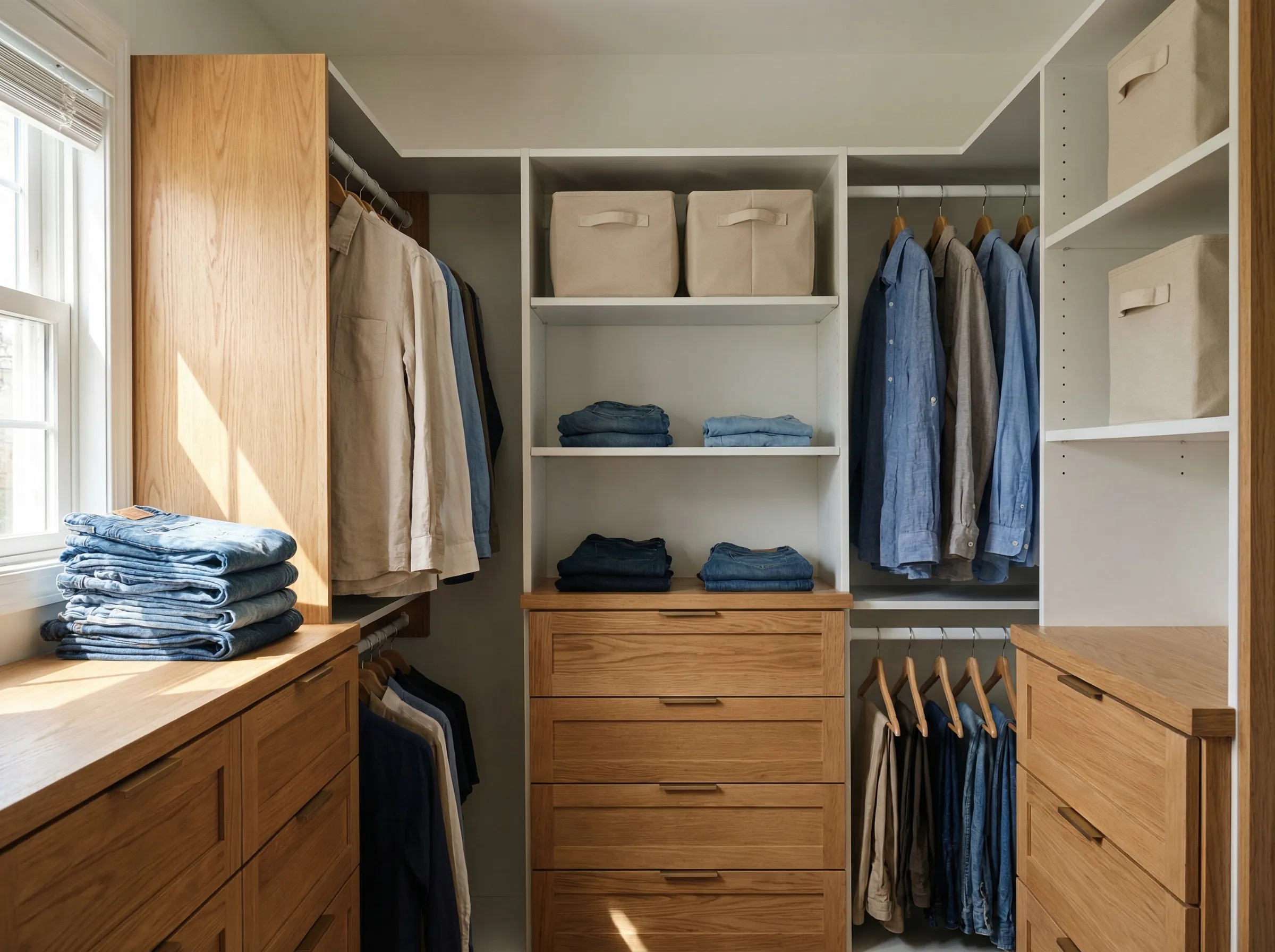
Serving Leander? See our Leander service area.
For scope references: Closet & Interior Installations and Custom Closets.
Leander closet priorities (what usually drives the project)
- Builder-grade wire shelving that wastes space
- Kids’ closets that overflow and never reset
- Shared primary closets with no clear zones
- Need for “drop zones” (bags, shoes, sports gear)
A realistic project timeline
| Phase | What happens | Typical timeline |
|---|---|---|
| Discovery + measure | Routine walkthrough + precise measurements. | 30–90 minutes |
| Design + quote | Options + tiers + accessories. | 2–10 business days |
| Fabrication | Materials cut/finished; hardware ordered. | 2–6 weeks |
| Install | Most single-room installs are quick. | 1–3 days |
What to do before your design appointment (saves time and improves the plan)
Installers can design faster (and more accurately) when you show real inventory and constraints:
- Take 6–10 photos per closet (wide shots + corners + door swing)
- Count shoes roughly (and note boots/athletic gear)
- Identify long-hang needs (dresses, coats) vs folded storage
- Decide if you want hampers inside the system or separate
- Note anything “weird” (out-of-square walls, attic access panels, vents)
If you want a high-clarity consult, bring a rough budget range and your top 3 priorities. It keeps the design focused.
Kids’ closets that evolve (the easiest win)
Design for growth:
- Adjustable shelves for bins and backpacks
- Lower rod now, move it up later
- A dedicated “school zone” (shoes + jacket + bag)
- Closed lower storage to reduce visual clutter
If clutter lives outside closets too, pairing with Garage & Pantry Organization can make the whole home feel easier.
Shared primary closets: the “two-person system” that stays organized
Shared closets fail when both people share the same space with no rules. A better layout:
- Clear left/right zones to prevent drift
- A shared “landing shelf” for daily items
- Dedicated shoe storage with visible slots (reduces floor pile behavior)
Materials and indoor air quality
If you want healthier materials and fewer odors:
- Ask about NAF/ULEF options and low-VOC finishes
- Ask what’s used for panel cores and edge banding
- Prioritize durable hardware (soft-close hinges and full-extension slides)
Reference: EPA formaldehyde guidance
Materials + hardware tiers (what drives longevity)
Ask what tier you’re buying:
| Category | Baseline | Better | Best |
|---|---|---|---|
| Drawer slides | Basic | Full-extension | Full-extension + higher load rating |
| Hinges | Standard | Soft-close | Soft-close + heavier-duty |
| Finish | Standard | Upgraded | Premium + lower-emission options |
Accessory costs (what commonly changes the quote)
Accessories add daily convenience, but they should be itemized:
| Add-on | Why it matters |
|---|---|
| Integrated lighting | Improves usability and makes closets feel finished. |
| Pull-out hampers | Reduces laundry pile behavior. |
| Shoe walls / angled racks | Prevents floor piles and keeps pairs visible. |
| Jewelry inserts / valet rods | Speeds up routines and reduces clutter surfaces. |
Starter packages (clear scopes for clear quotes)
| Package | What’s included | Best for |
|---|---|---|
| Reach-In Refresh | Shelves + drawers + double-hang | Bedrooms and kids’ rooms. |
| Primary Walk-In Upgrade | Zones + lighting + shoe/jewelry storage | Shared closets and busy mornings. |
| Whole-Home Storage Bundle | Closets + pantry/garage systems | Families who want the house to stay reset. |
Quote checklist (Leander edition)
- Are material tiers (finish + hardware) clearly defined?
- Are accessories itemized (shoes, hampers, jewelry, pull-outs, lighting)?
- Is demo/haul-off included and itemized?
- What is the lead time for revisions and fabrication?
- Does the layout reflect real routines and inventory?
Common mistakes to avoid (Leander edition)
- Not planning for growth in kids’ closets (adjustability matters)
- Skipping drawers (they reduce clutter far more than extra shelves)
- Overcomplicating categories (simple zones stay organized)
- Not itemizing accessories (hard to compare quotes without it)
Quick FAQ
Can a reach-in closet really feel “custom”?
Yes. Reach-ins often deliver the biggest ROI because a few drawers, double-hang sections, and better shelf spacing eliminate wasted vertical space.
Do I need to empty everything before install day?
Usually yes. Ask your installer for a prep checklist and whether demo/haul-off is included.
How do I keep a closet organized after install?
Design around routines: a landing shelf for daily items, a defined shoe system, and fewer “misc” categories. Good design reduces the need for willpower.
What’s a realistic lead time in the Austin metro?
Many projects land in the 2–6 week fabrication window after design approval, but it varies by material tier and season. Ask for the timeline in writing so you can plan around travel and events.
Should I choose “small reach-in upgrades” or one big closet first?
If clutter is spread across multiple rooms, a few reach-in refreshes often outperform one luxury closet—because they reduce daily pile behavior everywhere.
If you’re planning a whole-home storage reset, pairing bedroom closets with Garage & Pantry Organization is often what keeps clutter from migrating back into living areas.
Start your Leander project
If you want custom storage that fits real routines (and stays functional as your household changes), we can connect you with vetted designers and installers serving Leander.
Ready for next steps?
Tell us what you’re planning and we’ll match you with vetted local pros who can quote the work and explain the tradeoffs for your property.