
Insights
Complete Guide to Sustainable Landscaping in Georgetown, TX
Published September 6, 2025
Quick Summary
- Who this is for: Georgetown homeowners (including Sun City) who want a tidy, low-water yard that works with clay soil and aging-in-place priorities.
- Outcome: A drainage-aware plan that reduces puddling and maintenance while keeping beds crisp and intentional.
- Cost/Timeline: Many projects land in $3,500–$40,000+ depending on drainage fixes, irrigation tuning, and how much structure (paths/edging) is included.
How much does sustainable landscaping cost in Georgetown, TX?
In Georgetown, sustainable landscaping typically costs $3,500–$12,000 for a focused refresh, $8,000–$18,000 for a structured partial conversion, and $15,000–$40,000+ when clay-soil drainage corrections and irrigation retrofits are required. Budgets climb when water pooling near the slab edge forces grading, downspout routing, and rain-garden-style capture zones.
| Scope | Typical Range | Notes |
|---|---|---|
| Native planting refresh + irrigation tuning | $3,500 – $12,000 | Great for front beds, side yards, and foundation-adjacent fixes. |
| Partial lawn replacement (structured + tidy) | $8,000 – $18,000 | Paths/edging drive the finished look. |
| Full conversion + drainage/soil work | $15,000 – $40,000+ | Clay soil and runoff fixes often add scope. |
Use the 2025 xeriscaping cost guide for line-item budgeting and a quote checklist.
Serving Georgetown? See our Georgetown service area.
Georgetown reality: clay soil makes water management the design
Clay soil changes the rules:
- Water infiltrates slowly (puddles happen)
- Dry spells shrink clay and open gaps
- Poor grading sends water toward the slab edge
That’s why the best sustainable landscapes start with drainage logic and then layer in plants.
If you want the “what’s included” overview, start here: Landscaping services overview.
The tidy native yard (especially popular in Sun City)
Many Georgetown homeowners want low-maintenance, but not “wild.” These choices keep things intentional:
- Defined edges (steel/stone) to prevent bed creep
- Repeated shrubs for structure (so it reads “designed”)
- Smooth, safe walking routes (important for aging-in-place)
- Lighting that reduces trip hazards without glare
A low-maintenance design checklist (great for aging-in-place)
If your goal is “easy and safe,” ask designers to show how they’re addressing:
- Stable walking routes: consistent thresholds, fewer abrupt edges
- Visibility: lighting along transitions and steps
- Seasonal care: how much pruning and cleanup is expected (and when)
- Weed pressure: mulch depth, edging, and maintenance expectations
Rain-garden thinking (a sustainable fix for chronic puddles)
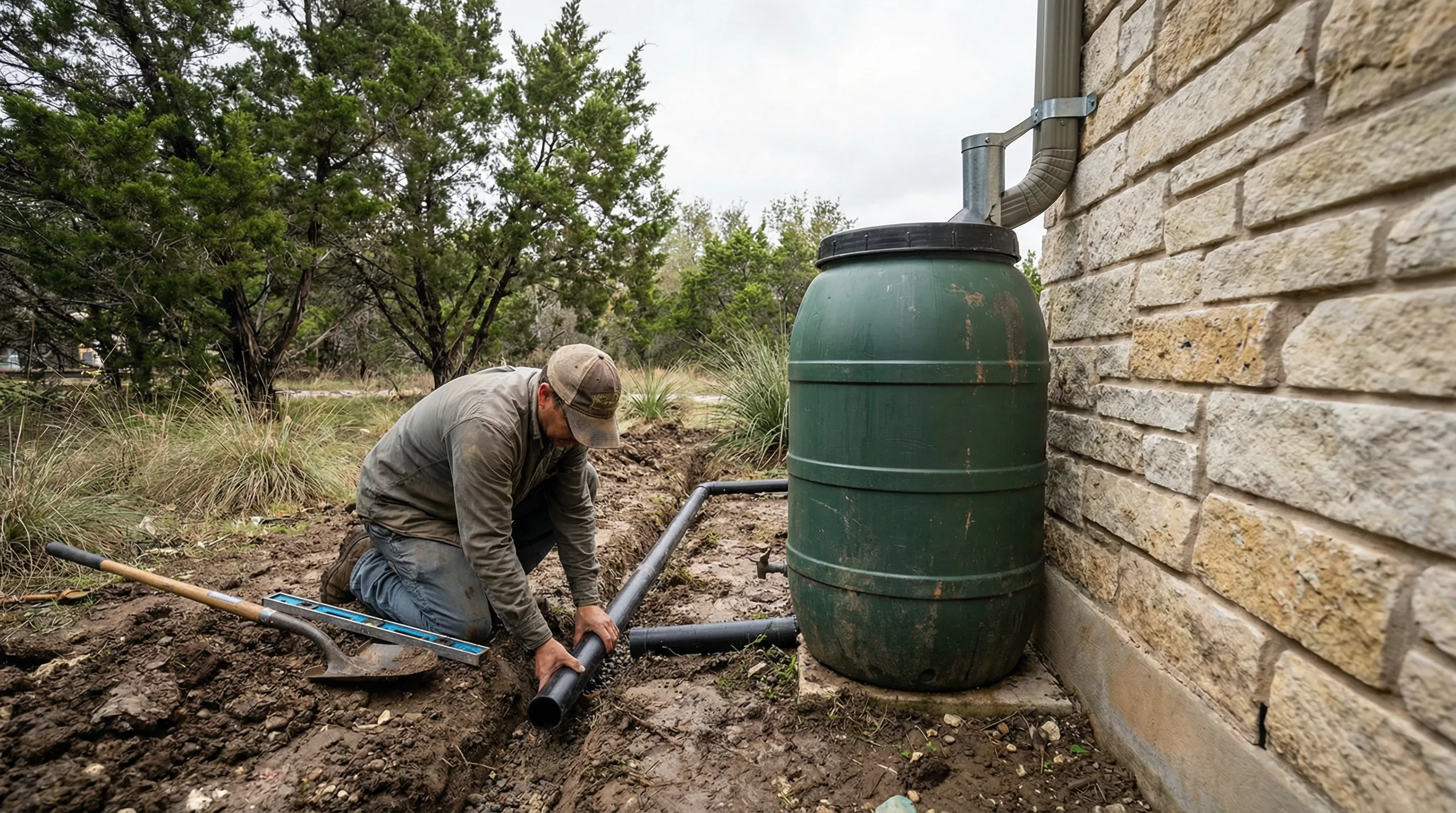
A rain garden is a shallow, planted basin that helps slow and absorb runoff. You don’t need a massive bioswale to benefit—sometimes it’s a small basin near a downspout outlet that prevents water from pooling against the house.
For a plain-English primer on runoff and erosion concepts, the City of Austin Watershed Protection resources are useful even outside Austin.
A simple “rain garden” starter approach
You don’t have to start big. Many homeowners begin with:
- Identify where downspouts and runoff currently pool.
- Create a shallow planted basin or widened bed to capture that water.
- Use plants that can handle occasional wet periods, then dry spells.
- Ensure the overflow route is intentional (so water doesn’t head toward the house).
Planting strategy for Georgetown (simple, repeatable, low-water)
Build a palette that prioritizes:
- Heat resilience
- Seasonal bloom cycles
- A few repeat “structure” plants
For plant selection guidance and Central Texas references:
Irrigation on clay: don’t overwater and drown roots
Clay soils hold moisture longer. Sustainable irrigation often means:
- Less frequent watering, but deeper cycles
- Separate zones so shade beds don’t get overwatered
- Pressure regulation to reduce runoff
Learn more: Irrigation Installation & Repair
Irrigation: the “less often, deeper” approach
Sustainable landscapes still need establishment watering, but the long-term goal is fewer, deeper watering cycles:
- Drip irrigation in beds
- Separate zones for sun vs shade
- Smart controllers to reduce waste
Learn more: Irrigation Installation & Repair
Starter projects that deliver fast ROI in Georgetown
| Starter project | Typical Range | Best for |
|---|---|---|
| Downspout + bed retrofit | $2,500 – $8,000 | Fix pooling near the slab edge with planting + grading. |
| Entry “no-mow” refresh | $6,000 – $14,000 | Curb appeal with tidy structure. |
| Side-yard shade garden | $4,000 – $10,000 | Low-effort improvement to a neglected zone. |
| Irrigation efficiency upgrade | $800 – $5,000 | Stop misting/runoff; protect new plants. |
Maintenance calendar (what “low maintenance” looks like in real life)
- Spring: prune, refresh mulch, check irrigation emitters and leaks
- Summer: deep watering, check puddling after storms, spot-weed quickly
- Fall: cut back perennials after blooms, compost top-dress if needed
- Winter: freeze protection for young plants; cleanup pass before spring growth
If wildlife habitat matters, certification checklists are useful frameworks:
Quote checklist (Georgetown edition)
- Do they identify drainage paths and low spots before proposing plants?
- Are plant sizes specified (1/5/15-gallon) and does the plan phase well?
- Is the irrigation scope clear (zones, drip, controller settings)?
- Do they include a first-season care plan and realistic maintenance expectations?
- Are walking routes designed with safe transitions and non-slip surfaces?
Common mistakes to avoid (Georgetown edition)
- Ignoring water flow on clay. Puddling is a design problem, not a “bad week of rain.”
- No edging or structure. Native beds look messy without clear borders.
- Overplanting small plants too close. Mature spacing matters for long-term tidiness.
- Underestimating establishment care. The first season determines success.
If you want a full-site plan that’s designed around water flow (not just a plant list), start with Sustainable Landscape Design. If you’re explicitly replacing turf and reducing irrigation demand, Xeriscaping & Drought-Resistant Design is usually the right scope anchor.
Start your Georgetown plan
If you want a tidy, low-water yard that’s designed for clay soil and everyday ease, we can connect you with sustainable landscape pros who prioritize drainage and long-term maintainability.
Ready for next steps?
Tell us what you’re planning and we’ll match you with vetted local pros who can quote the work and explain the tradeoffs for your property.