
Insights
Complete Guide to Sustainable Landscaping in Round Rock, TX
Published September 10, 2025
Quick Summary
- Who this is for: Round Rock homeowners who want a low-water yard that still works for family life (kids/dogs) and stays tidy.
- Outcome: A clay-aware plan that reduces runoff and watering waste while keeping beds crisp and intentional.
- Cost/Timeline: Many projects land in $3,500–$40,000+ depending on clay-soil drainage fixes, irrigation tuning, and structure (paths/edging).
How much does sustainable landscaping cost in Round Rock, TX?
In Round Rock, sustainable landscaping typically costs $3,500–$12,000 for a focused refresh, $8,000–$18,000 for a structured partial conversion, and $15,000–$40,000+ when drainage corrections and irrigation retrofits are required. Round Rock’s clay expands when wet, so ignoring water flow can turn new beds and edging into repeated repairs.
| Scope | Typical Range | Notes |
|---|---|---|
| Native beds + irrigation tuning | $3,500 – $12,000 | Strong first phase for most homes. |
| Partial lawn replacement (structured) | $8,000 – $18,000 | Edging + paths deliver the tidy look. |
| Full conversion + drainage corrections | $15,000 – $40,000+ | Clay soil + runoff fixes can add scope. |
Use the 2025 xeriscaping cost guide for a line-item budgeting checklist.
Serving Round Rock? See our Round Rock service area.
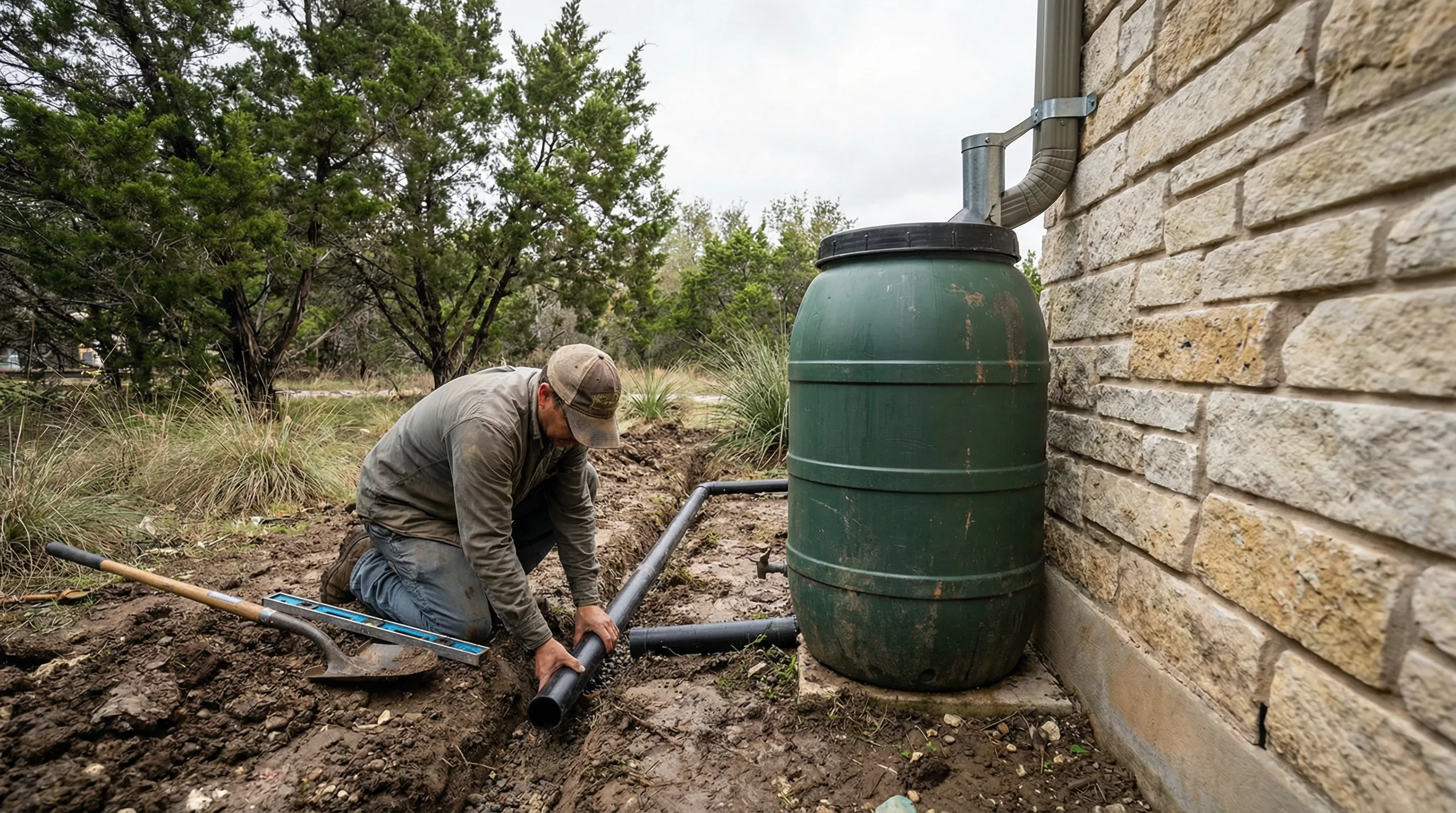
Round Rock sustainable landscaping: solve water flow first
Even when the project is “just landscaping,” water flow drives success:
- Do downspouts dump into beds with no plan?
- Do you get puddling near doors or slab edges?
- Does mulch wash away after storms?
For runoff concepts and visuals, the City of Austin Watershed Protection resources are a good reference for Central Texas.
If you want the service-level overview, start with Landscaping services.
A “tidy native” yard that still works for families
Many Round Rock homeowners want low water and a yard that still works for kids and dogs. A balanced plan often looks like:
- A smaller turf footprint where play actually happens
- Defined planting beds with clear borders (so they don’t “creep”)
- A path network that keeps traffic off beds (and reduces mud tracking)
- Shade-first design for comfort in July and August
If you’re planning a more structured conversion, start with Xeriscaping & Drought-Resistant Design and use this guide to pick the first phase.
Irrigation strategy (reduce waste, protect plants)
Round Rock summers punish shallow, frequent watering. Better pattern:
- Drip irrigation in beds
- Fewer, deeper watering cycles
- Split zones by sun exposure
Learn more: Irrigation Installation & Repair
Family-friendly sustainable yards (a balanced plan)
Many families do best with a hybrid approach:
- Keep a small turf footprint where kids/dogs actually play
- Replace everything else with structured beds and paths
- Use shade-first design to make outdoor space comfortable
Plant selection: build a repeatable palette (not a random plant list)
Instead of a long plant list, build a small palette you repeat in groups:
- 1–2 shrubs for structure (repeated in multiple beds)
- 2–3 perennials for staggered color waves (also repeated)
- 1 accent plant used sparingly for focal points
Then use edging and paths to keep the design reading as intentional.
Plant selection: use proven Central Texas sources
Starter projects that make progress without chaos
| Starter project | Typical Range | Best for |
|---|---|---|
| Entry bed refresh + repeats | $3,500 – $9,000 | Curb appeal without full conversion. |
| Side-yard conversion | $4,000 – $10,000 | Easy win for a neglected zone. |
| Partial lawn replacement (front) | $8,000 – $18,000 | HOA-friendly “no-mow” that looks tidy. |
| Irrigation efficiency upgrade | $800 – $5,000 | Stop misting/runoff and protect new plants. |
Establishment plan (the first season makes or breaks the yard)
Ask any contractor to define the first-season plan:
- Watering schedule by zone (full sun vs shade)
- Mulch depth and weed strategy during establishment
- What “normal” loss looks like and how replacements are handled
Maintenance calendar (what “low maintenance” looks like)
- Spring: prune, refresh mulch, adjust drip emitters
- Summer: deep watering cycles, spot-weed after storms, check irrigation for clogs
- Fall: cut back perennials after blooms, refresh mulch, plant cool-season natives
- Winter: freeze protection for young plants; cleanup pass before spring growth
If habitat value is part of your goal, certification checklists are helpful frameworks:
Quote checklist (Round Rock edition)
- Is the plan zoned by sun exposure and square footage?
- Are plant sizes specified and tied to establishment care?
- Is irrigation described as drip zones + controller settings?
- Do they describe weed strategy and realistic maintenance?
- Do they address drainage paths before installing beds?
Common mistakes to avoid (Round Rock edition)
- Overwatering beds like turf. Beds need different cycles than grass.
- No edging. Without structure, native beds read messy and expand over time.
- Too many plant varieties. Repeats look designed and reduce maintenance complexity.
- Ignoring downspouts. Downspout routing is often the hidden driver of washouts and puddles.
A simple 3-phase plan (so you don’t redo work)
- Fix water flow + irrigation efficiency.
- Build structure (edging + paths) so the yard reads intentional.
- Add plant “drifts” in repeatable palettes and expand zone by zone.
Phasing keeps budgets predictable and avoids tearing up finished beds to correct water problems.
If you want a plan that ties together drainage, structure, and planting, start with Sustainable Landscape Design. If your goal is reducing turf and water use, Xeriscaping & Drought-Resistant Design is usually the right scope anchor.
Start your Round Rock plan
If you want a sustainable yard that works for real family life, we can connect you with specialists who design for Central Texas heat, drainage, and long-term maintainability.
Ready for next steps?
Tell us what you’re planning and we’ll match you with vetted local pros who can quote the work and explain the tradeoffs for your property.